REVIEW · CHINATOWN, LITTLE INDIA & KAMPONG GLAM WALKING TOURS
Kampong Glam and Little India Join-in Walking Tour
Book on Viator →Operated by Haloo Tours · Bookable on Viator
Follow street signs to two cultures at once. This join-in walk links Kampong Glam and Little India into one easy route, mixing landmarks like Sultan Mosque with streets known for food, shopping, and everyday community life. You also get a guide who explains what you’re seeing, including the why behind the buildings and the names.
I like two things most: the way the route flows, and the guide quality. Charles stood out in the feedback I saw, with clear answers, strong background stories, and even a route that adapts so you still cover both districts at a good pace.
One drawback to plan for: it’s a 3.5-hour walk and some stops have admission fees if you want to go inside. If you’re sensitive to walking time, wear good shoes and pace yourself.
In This Review
- Key things I’d circle before booking
- Kampong Glam and Little India as one smart combo
- Price and what you’re really buying at $84.75
- Meeting at Bugis and the rhythm of a 9:00 am start
- Haji Lane: street art and the old pilgrimage story
- Arab Street and Bussorah Street: what Sultan Mosque anchors
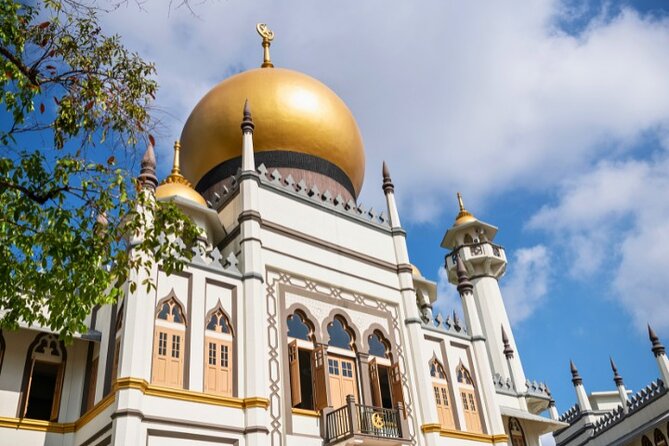
- Sultan Mosque (Masjid Sultan): the icon and the meaning
- Gedung Kuning and Istana Kampong Glam: royal-era buildings to spot
- Race Course Road: why the name matters in Little India
- Tekka Centre: market life without the tourist fog
- Former House of Tan Teng Niah: a Chinese villa inside Indian streets
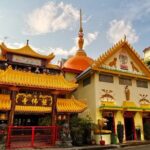
- Sri Veeramakaliamman Temple: one of the oldest Hindu temples
- Little India Arcade and Campbell Lane: shopping streets with conservation behind them
- The guide factor: Charles, questions, and a route that makes sense
- What suits you best (and who should think twice)
- Practical tips to enjoy it more
- Should you book this Kampong Glam and Little India tour?
- FAQ
- FAQ
- How long is the walking tour?
- What is the price per person?
- Where do you meet and where does the tour end?
- What time does the tour start?
- Is the guide English speaking?
- How many people are in the group?
- Is admission included for every stop?
- Do I need a printed ticket?
- What cancellation window is available for a full refund?
- What physical fitness level is recommended?
Key things I’d circle before booking
- Licensed English-speaking guide: you get explanations (not just a pointing-and-walking tour).
- Small group size (max 15): easier to hear, and the guide can answer questions without rushing.
- Free-look stops mixed with paid entries: several major sites are free to access, but a few buildings are not included.
- A real cross-district route: you cover Kampong Glam first, then head over to Indian community areas by MRT.
- Market time at Tekka Centre: it’s built for hands-on street-level Singapore, not just monuments.
Kampong Glam and Little India as one smart combo
Singapore’s cultural identity shows best when you don’t keep it in separate boxes. This tour connects two neighborhoods that feel worlds apart at first glance, but share the same big theme: communities shaped by migration, trade, and faith.
Kampong Glam is the historic Malay and Arab quarter, with streets that echo older patterns of religious travel and neighborhood life. Little India brings you the other side of that story: Hindu temples, Chinese villas tied to business families, and shopping streets where local culture stays in motion.
What makes the combination work is that you’re not just “seeing.” You’re walking through the places where people still live, shop, pray, and eat. That’s the difference between a photo tour and one that helps you understand the city.
You can also read our reviews of more walking tours in Singapore


Price and what you’re really buying at $84.75
At $84.75 per person for about 3 hours 30 minutes, you’re paying for a few clear things:
- A licensed English-speaking tourist guide
- A planned route that spans two districts
- Time at major landmark areas plus street-level stops
Most tours like this would charge you extra for guidance, and then you’d still be figuring out what to look at on your own. Here, the guide’s job is to connect the dots: why a street has a certain role, why a mosque was built when it was, and why certain buildings ended up where they are.
The one cost detail to keep in mind: admission fees aren’t included. Some stops are free to access, while others list ticketing as not included. If you want to enter every building, budget some extra money on top.
Meeting at Bugis and the rhythm of a 9:00 am start
You start at Bugis (meeting point: Bugis) at 9:00 am, and you finish in Little India. That matters because it affects how you plan the rest of your day.
Starting near Bugis is convenient. You’re already in an area with plenty of transport options and easy morning energy. And ending in Little India means you can roll right into lunch, shopping, or temple-area wandering without backtracking.
This is also a group tour with a maximum of 15. That small cap is a big deal in Singapore, where sidewalks can be tight and attractions can draw crowds. With a smaller group, you spend more time listening and less time waiting.
Haji Lane: street art and the old pilgrimage story
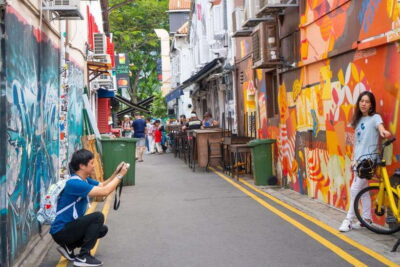
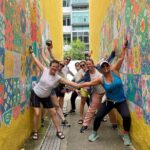
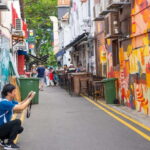
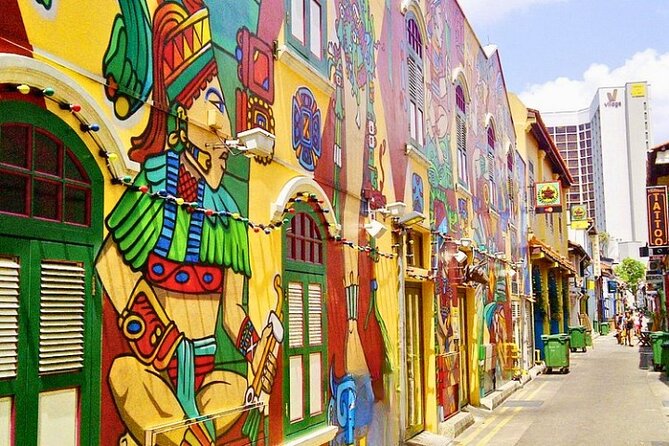
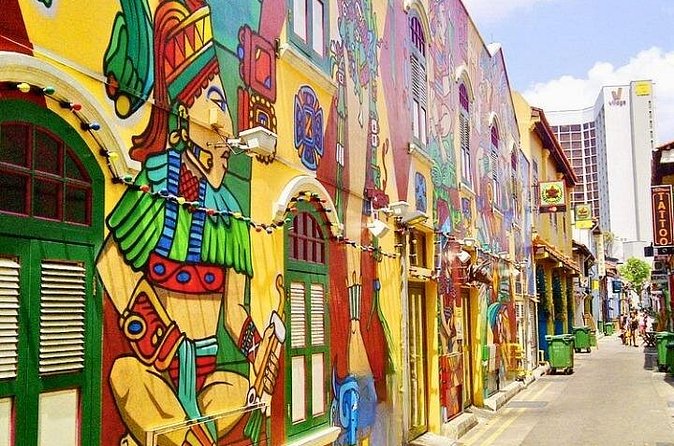
The walk kicks off at Haji Lane, a narrow alley known for colorful street art, indie boutiques, and hip cafés. The fun part is that it’s not just a modern hangout.
Haji Lane also has older roots. It was once a place where Muslim pilgrims stayed while traveling to Mecca. That makes the lane feel layered. You can look at the artwork and shops, sure—but then you can also understand why this lane became a symbolic “waystation” in older days.
Practical note: it’s an alley, so you’ll likely be moving slowly through it. Comfortable shoes help, and quick photos are the move because the lane is meant for strolling, not lingering in one spot.
Arab Street and Bussorah Street: what Sultan Mosque anchors
Next comes Arab Street, centered around Sultan Mosque in Kampong Glam. The road is associated with Islamic heritage, along with textile shops and Middle Eastern eateries. In other words, this isn’t just a street with tourist signs—it’s a commercial spine tied to the community around the mosque.
Then you move to Bussorah Street, right in front of Sultan Mosque. This street is lined with heritage shophouses and mixes Middle Eastern cuisine with souvenir shopping. It’s a good place to walk, pause, and look up at building fronts while your guide explains the area’s role.
If you like context, this segment is worth paying attention to. You’ll get a clear sense of how the mosque isn’t an isolated landmark. It’s an anchor that shaped streets, shops, and movement in the neighborhood.


Sultan Mosque (Masjid Sultan): the icon and the meaning
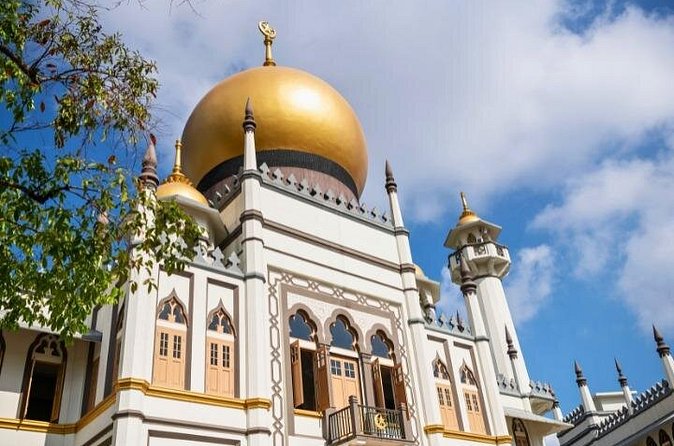
Sultan Mosque is one of Singapore’s best-known religious landmarks. The tour highlights that it was built in 1824 for Sultan Hussein Shah, the first sultan of Singapore, and that it became a centerpiece of Kampong Glam.
A lot of people stop here just to look. The better approach is to listen to what the guide explains about its place in the neighborhood and why this site became such an important symbol for early leadership and community life.
The stop includes free access for viewing, so it’s low-stress to spend time here. Still, be respectful. This is an active place of worship, not an open-air museum.
Gedung Kuning and Istana Kampong Glam: royal-era buildings to spot
After the mosque area, the tour shifts to two heritage buildings that you’ll see as part of the Kampong Glam story.
First is Gedung Kuning, meaning Yellow Mansion in Malay. It’s tied to the royal residence of Malay nobility and was built in the 1850s. Today, it houses a restaurant and cultural uses, which is a common Singapore pattern: older structures get adapted for modern daily life.
Then there’s Istana Kampong Glam, built in the 1840s and once the royal residence of Sultan Hussein Shah and descendants. Today it houses the Malay Heritage Centre.
Important practical point: both of these list admission as not included. That doesn’t mean you can’t see them. It means if you want to go inside for exhibitions, you’ll need separate tickets. If your priorities are exterior architecture plus street-level culture, you’ll still get plenty from the stop.
Race Course Road: why the name matters in Little India
To move into Little India, the tour uses MRT between districts, which keeps things efficient. Once you arrive, you start with Race Course Road, a street whose name comes from the Serangoon Road Race Course—Singapore’s first horse racing track established in 1842, at what is now Farrer Park.
Names like this are sneaky. They look like they belong to local history only, but they’re often the leftover fingerprints of older city plans and economic priorities. Even if you don’t care about horse racing, you can use this stop as a shortcut to understanding that Singapore keeps changing, but the “old map” still shows up in the street signs.
Tekka Centre: market life without the tourist fog
Tekka Centre (also called Tekka Market) is a multi-use complex in Little India. It includes a wet market, a hawker centre, and shops. The site dates back to 1915, and the current location was reconstructed in 1982.
This is one of the most practical stops on the whole walk. It’s the kind of place where the city feels like itself—where food and daily errands are close together. It’s also a smart moment to buy a quick snack or browse what’s on offer, since it’s set up for that kind of browsing.
Access here is listed as free for the tour stop, so you’re not stuck paying entry fees just to experience the vibe. If you’re picky about food smells, this might still be a lot. But if you like street-level Singapore, you’ll get a strong hit of it here.
Former House of Tan Teng Niah: a Chinese villa inside Indian streets
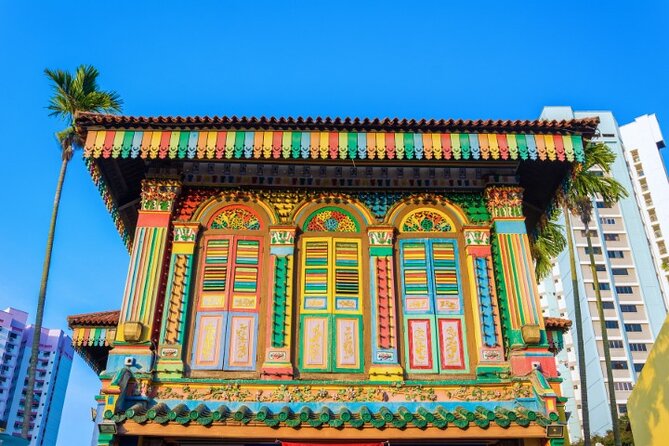
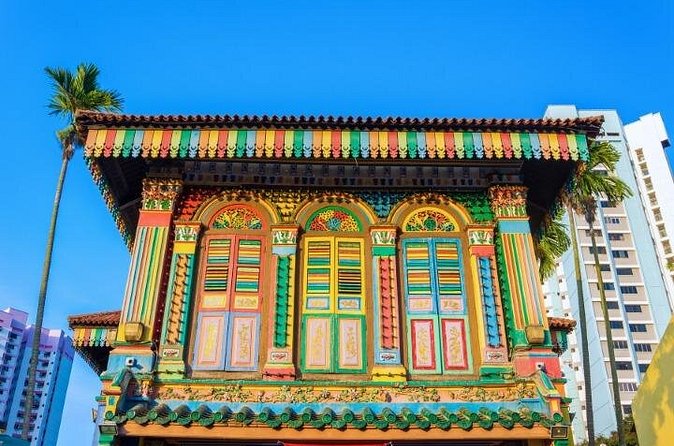
One of the more interesting contrasts in Little India is the Former House of Tan Teng Niah. This is a vividly painted Chinese villa built in 1900 by a confectionery tycoon named Tan Teng Niah. The tour also notes it as the neighborhood’s last surviving Chinese villa in the area.
This stop is a great reminder that Little India wasn’t shaped by one community alone. Business, migration, and street-level commerce created mixed footprints. The tour’s framing helps you see the neighborhood as a layering of families and work—not just a single cultural label.
Admission is listed as not included here, so you may be viewing from the outside depending on how the tour handles time. Either way, the building’s story gives you more than just a photo.
Sri Veeramakaliamman Temple: one of the oldest Hindu temples
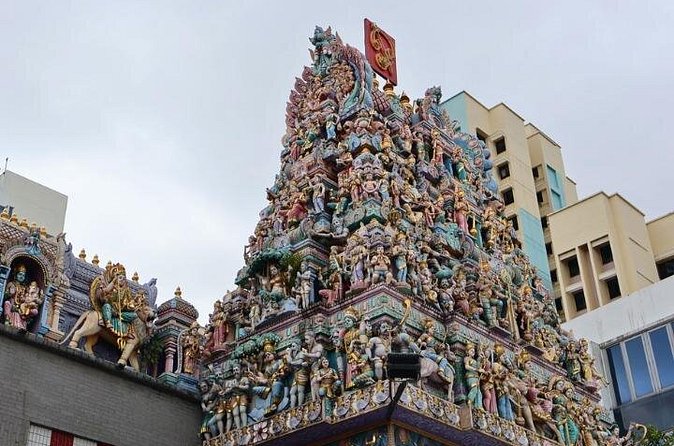
Next is Sri Veeramakaliamman Temple, described as one of Singapore’s oldest Hindu temples. The tour says it started as a shrine in 1855 and was rebuilt in 1881 by Indian pioneers on Serangoon Road in Little India.
This is a stop where the guide’s commentary matters. It helps you connect age, rebuilding, and the role of the temple in community continuity. It’s also one of the stops listed as free for viewing.
If you’re the type who likes to observe how different faiths appear in public life, this temple stop is one of the best “meaning per minute” parts of the walk.
Little India Arcade and Campbell Lane: shopping streets with conservation behind them
The tour includes Little India Arcade, housed in a cluster of conserved neoclassical shophouses built in 1913. It was officially opened in 1995, and the development is linked to the Hindu Endowments Board.
Even if you don’t plan to shop, the value here is the architecture and conservation story. Singapore often protects older street-scale buildings and keeps them useful. You can see that pattern in the way this arcade is set up in older shophouse form.
Then there’s Campbell Lane, a pedestrian street known for cultural heritage and a lively atmosphere. The tour notes it shifted from a thoroughfare for livestock trade into today’s food and shopping focused street life.
Campbell Lane is the kind of place where your guide can help you interpret why it feels so crowded and local at the same time. You’re watching the residue of older trading functions turning into modern neighborhood routines.
The guide factor: Charles, questions, and a route that makes sense
The strongest praise in the feedback is the guide. Charles comes up repeatedly as well informed, helpful, and quick to answer questions. One review even highlighted that the route was planned well so you could move through Kampong Glam first, then hop on the MRT to reach the Indian community areas without losing time.
That personalization matters more than people think. A good guide doesn’t just recite facts. They adjust based on what you care about and how quickly you move. On a 3.5-hour walk, that makes the difference between feeling rushed and feeling like you actually got your bearings.
If you enjoy asking questions, this tour is set up for that. The overall pattern of comments points to a guide who doesn’t shut down beyond the prewritten script.
What suits you best (and who should think twice)
This tour fits you if you want:
- A structured walk with a licensed guide
- A cross-neighborhood day that starts in Kampong Glam and ends in Little India
- Street-level Singapore: mosques, temples, markets, shophouses, and heritage building stories
It’s not ideal if:
- You don’t do well with walking for about 3.5 hours
- You want every interior visit to be included for no extra cost (some stops have admission fees not covered)
Also note: it’s “join-in,” capped at 15. That’s great for attention, but it also means you’re sharing space with others and your pace depends on group flow.
Practical tips to enjoy it more
- Wear comfy shoes. You’re moving through streets and lanes, not museum halls.
- Bring water. Even with breaks, you’ll cover a lot of sidewalk.
- If you’re curious about inside visits, decide ahead of time which buildings you want to enter since admission isn’t included.
- Have your phone camera ready for street art and building exteriors, especially around Haji Lane and the shophouse areas.
Should you book this Kampong Glam and Little India tour?
Yes, if you want an efficient, guided way to understand Singapore’s multicultural neighborhoods through real streets and real landmarks. The guide-led storytelling is the standout feature, and the mix of free-access stops with heritage buildings keeps the value strong.
Book it especially if you like to know what you’re looking at. Sultan Mosque, Sri Veeramakaliamman Temple, Tekka Centre, and the heritage shophouse streets don’t just look good on a map—they make more sense when someone connects the dots for you.
FAQ
FAQ
How long is the walking tour?
The tour runs for about 3 hours 30 minutes.
What is the price per person?
The price is $84.75 per person.
Where do you meet and where does the tour end?
You start at Bugis (meeting point: Bugis) and end in Little India, Singapore.
What time does the tour start?
The tour starts at 9:00 am.
Is the guide English speaking?
Yes. The tour includes an English Speaking Licensed Tourist Guide.
How many people are in the group?
The tour has a maximum of 15 travelers.
Is admission included for every stop?
No. Admission fees are not included, and some stops specifically list admission tickets as not included.
Do I need a printed ticket?
No. The tour uses a mobile ticket.
What cancellation window is available for a full refund?
You can cancel up to 24 hours in advance for a full refund.
What physical fitness level is recommended?
The tour recommends travelers have a moderate physical fitness level.