REVIEW · CHINATOWN, LITTLE INDIA & KAMPONG GLAM WALKING TOURS
Splendour of Colonial Singapore Walking Tour with Lunch
Book on Viator →Operated by On-A-Roll-Tours · Bookable on Viator
Colonial Singapore has a clockwork feel. This walking tour traces how British rule shaped the city’s layout, courts, churches, schools, and riverside life.
I love the mix of famous and lesser-visited buildings, from St Andrew’s Cathedral to the Arts House, plus the free-entry sights that make the route feel efficient. I also like that lunch is built in: a 3-course meal by Boat Quay keeps the day relaxed instead of turning into yet another fast skip-and-go.
One consideration: you’ll be walking through the Civic District and Old European Town for about 3.5 hours, so bring comfy shoes and expect some sun along the river segment.
In This Review
- Key highlights you’ll actually care about
- Colonial Singapore, explained in walkable streets
- From City Hall to St Andrew’s Cathedral: the Anglican start
- National Gallery Singapore: two colonial powerhouses, now art space
- The Arts House and Victoria Theatre: when older buildings keep working
- Civic offices, then the Singapore River: engineering you can walk over
- Fullerton Shop (former General Post Office) and the lunch at Boat Quay
- Supreme Court: maximum-security architecture, explained in plain language
- Central Fire Station: oldest surviving fire station and real emergency history
- Armenian Apostolic Church of St Gregory: the oldest church in Singapore
- Pacing, timing, and how to get value from 3.5 hours
- Price and what you actually get for $55.61
- Who should book this tour (and who might skip it)
- Should you book Splendour of Colonial Singapore with Lunch?
- FAQ
- What time does the tour start, and how long does it last?
- Where do you meet, and where does the tour end?
- Is lunch included, and are there vegetarian options?
- Do I need to buy tickets for the stops?
- What’s included besides the tour and lunch?
- How big is the group?
- What’s the cancellation policy?
Key highlights you’ll actually care about
- Small group size (max 15) helps the guide keep everyone together and answer questions without rushing you
- Free admission sites on the route mean you’re not paying extra ticket fees for the big buildings
- Lunch by the river at Boat Quay is a real break, not just a photo stop
- Ping’s guiding style is consistently praised for clear English, pacing, and care for group safety
- Indoor stops with air conditioning help when Singapore heat hits
Colonial Singapore, explained in walkable streets
Singapore’s modern streets can feel orderly and efficient. This tour explains why. You follow the kind of town planning that came with the British trading post era, then the Straits Settlements period, and later the British crown colony era. Along the way, you see how power sat in physical form: churches, courts, civic buildings, and infrastructure all clustered in the downtown core.
The best part is the way the story connects to what you’re standing in front of. Instead of treating colonial architecture like a museum, the tour treats it like a working blueprint for the city. That makes the streets feel less random—and more like a system you can read with your own eyes.
If you like architecture, courts, churches, and city planning, this is a smart use of a half day.
You can also read our reviews of more walking tours in Singapore


From City Hall to St Andrew’s Cathedral: the Anglican start
You begin near City Hall MRT, which is handy if you’re trying to keep the logistics simple for a short stay. From there, the tour kicks off with St Andrew’s Cathedral, tying the early British presence to the founding of a trading post in 1819 and the growth of the European settlement.
The cathedral stop gives you a clear anchor: in 1836, the first Anglican church was constructed. Even if you’re not a church-history person, it’s a useful marker. It shows how colonial authority wasn’t only about commerce and government—it also showed up in religion and community spaces.
What to watch for: take a minute to look at the setting and how it fits the wider downtown. It helps the rest of the route make sense.
National Gallery Singapore: two colonial powerhouses, now art space
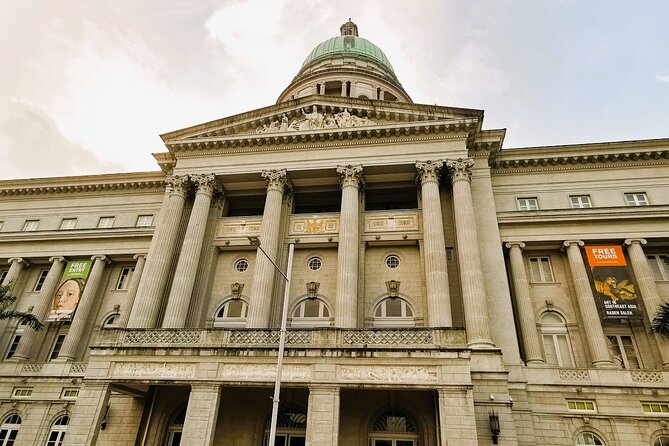
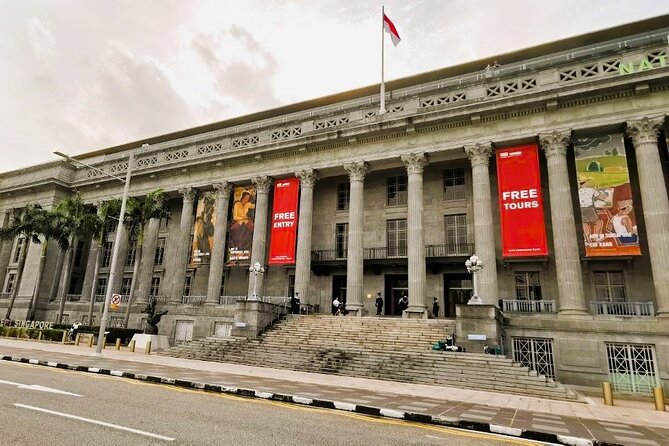
Next up is the National Gallery Singapore, which is made from two colonial buildings: the Former Municipal Building (later City Hall Building) and the Former Supreme Court Building. That’s the magic trick here. The exterior and structure still carry the original purpose, but today the spaces are repurposed for art.
You get about 40 minutes at this stop, and that’s enough time to do two things at once:
1) notice how civic and legal functions looked in architecture
2) connect those styles to what you see later in the tour
If you’ve ever wondered why some buildings feel “official” even when their use changes, this is your answer. Function lingers.
Possible drawback: because this is a major landmark, it can be busy at times. If you’re sensitive to crowds, go at a calm pace and focus on details the guide points out.
The Arts House and Victoria Theatre: when older buildings keep working
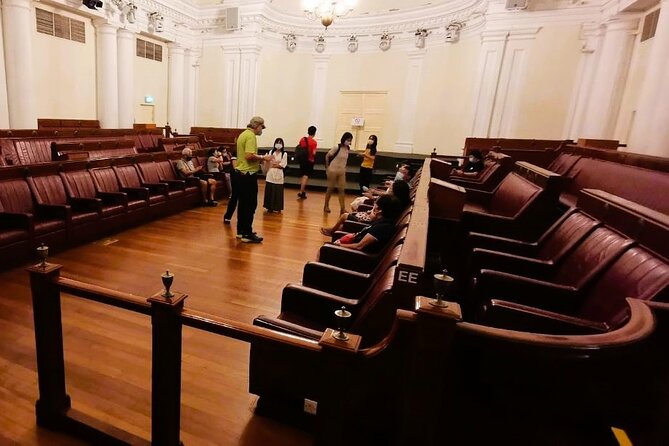
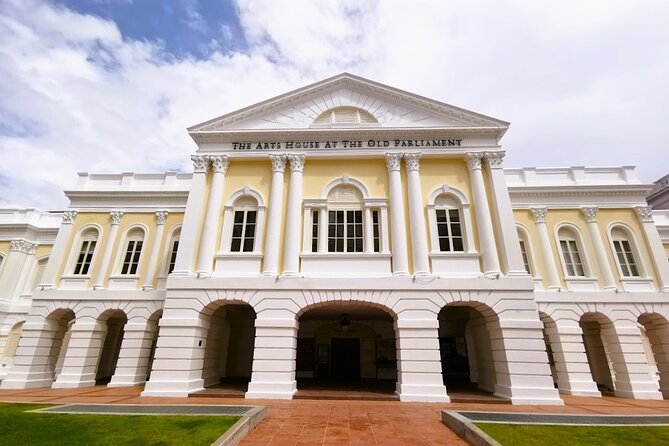
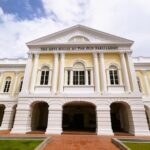
The Arts House stop focuses on the oldest surviving building in Singapore, dating to 1827. That matters because it’s not just old—it’s still in use. You’re basically seeing how preservation and adaptation can coexist.
Then the tour moves to Victoria Theatre & Victoria Concert Hall. The route explains how two separate buildings—one originally linked to the Town Hall and another connected with a memorial for Queen Victoria built more than 40 years later—were later amalgamated into one complex. It’s a clean lesson in how history gets physically layered.
You also get a quick look at a bronz-related detail (the tour mentions original bronz, though not much extra context is provided). The practical point is this: these stops aren’t random photo angles. Each one supports a theme—civic pride, public memory, and the way institutions evolved over time.
Why this works for real travelers: these are indoor-friendly stops. On hot days, that air-conditioned relief is not a small thing.
Civic offices, then the Singapore River: engineering you can walk over
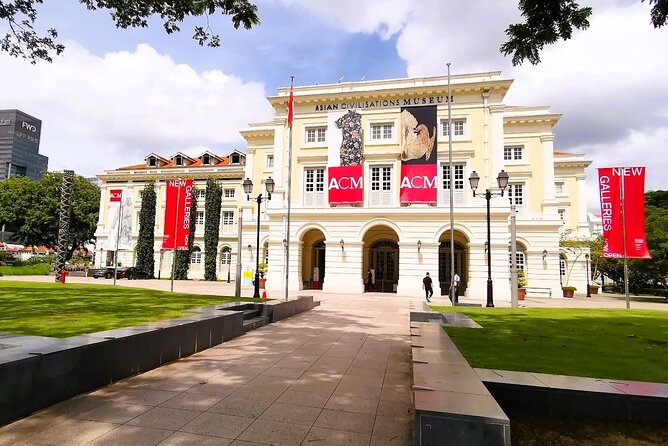
As the tour continues through the Civic District and Old European Town, you also pass the Former Government Offices of Colonial Singapore, described as an iconic neo-classical style colonial building with rainbow-coloured windows. Even without extra commentary, that kind of detail helps you remember where you are in the story—because it turns the downtown into a set of recognizable markers.
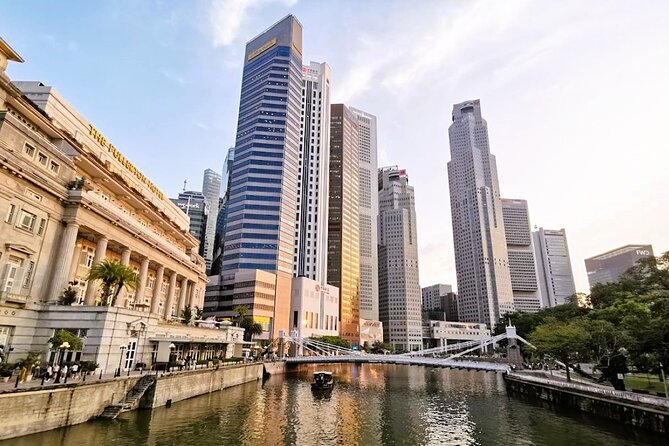
Then comes the river side segment and Cavenagh Bridge. The tour points out that this is the oldest surviving suspension bridge in Singapore, and it frames the walk across it as a way to picture life along the Singapore River about 200 years ago.
This bridge stop is short—around 10 minutes—but it’s a big perspective shift. Up to this point, you’ve been mostly in formal buildings. Here you’re connecting those institutions to trade, movement, and daily urban flow.
Tip: if you’re taking photos, the bridge and river angles can look best when you slow down for 30 seconds and let the view settle. Rush here and you’ll miss the reason you came.
You can also read our reviews of more tours and experiences in Singapore



Fullerton Shop (former General Post Office) and the lunch at Boat Quay
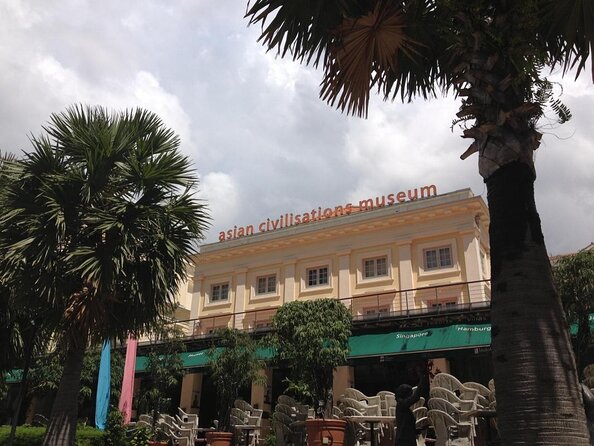
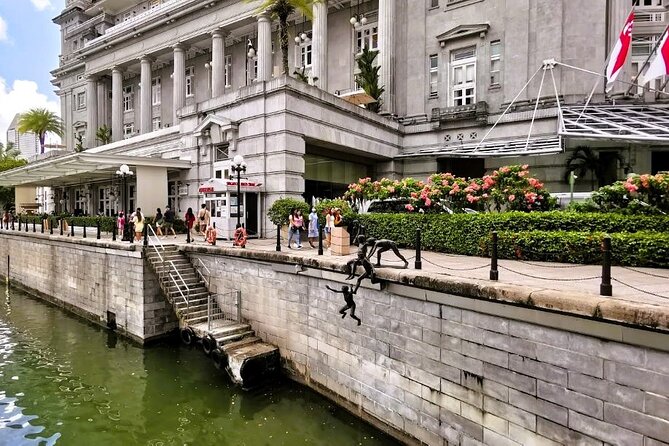
The tour then includes a stop at The Fullerton Shop. The building was formerly the General Post Office, and today it’s part of the Fullerton Hotel complex. The tour notes a heritage gallery worth visiting, and even if you only skim it, it’s a good “pause” between architectural stops.
Then lunch hits: a 3-course lunch by the river at Boat Quay, with vegetarian and non-vegetarian options. This is one of the clearest value moves in the whole experience. For many travelers, the day’s biggest hidden cost is food—so having it included makes the tour feel fair instead of just “cheap on paper.”
Lunch at Boat Quay also makes the story more human. You’re eating in the area linked to river trade and colonial-era movement, so the architecture isn’t floating in theory.
Based on guide quality comments, the meal is generally treated as a real break. Solo travelers especially seem to enjoy that the lunch gives time to ask questions without the pressure of constantly moving.
What to watch for: you’ll be walking off lunch afterward, so don’t go heavy on second helpings. Your future self will thank you.
Supreme Court: maximum-security architecture, explained in plain language
After lunch, you get to explore the Supreme Court. The tour description includes the building’s “spaceship-like” structure on top, which is a memorable visual cue. More important than the exterior shape is what the stop represents: the colonial-era legal system made “order” physical.
You have about 25 minutes here, which is enough for a guide-led explanation and for you to look around without feeling like you’re just standing in line.
If courts and governance sound dry on a menu, don’t skip this stop. The framing is what changes it. You’re not studying law as an abstract concept. You’re seeing how it influenced where people moved and what buildings were considered essential.
Central Fire Station: oldest surviving fire station and real emergency history
Next is Central Fire Station, described as the oldest surviving fire station in Singapore. Here you get the kind of detail that turns a history tour into a lived-feel experience: the presence of an antique horse-drawn fire truck and the chance to climb aboard a vintage fire engine.
This is one of the stops that often gets overlooked by visitors who think colonial buildings only mean government and churches. It broadens the story into services that kept a city alive.
For families, history lovers, and anyone who likes “stuff you can actually see,” this stop is a win. It adds texture to the bigger theme of infrastructure and civic planning.
Armenian Apostolic Church of St Gregory: the oldest church in Singapore
The tour ends at the Armenian Apostolic Church of St. Gregory the Illuminator, dating back to 1835. It’s the oldest church in Singapore, and the tour includes a note on significant contributions made by the Armenian community to Singapore.
Ending here is smart. You finish with a living institution connected to a specific community, not just the British storyline. That gives you a more complete feel for colonial-era Singapore as a place where multiple groups built their presence, not just one empire writing the whole script.
The walk ends near Hill Street, close to where you started, which helps if you want to continue exploring afterward without feeling stranded.
Pacing, timing, and how to get value from 3.5 hours
The tour runs about 3 hours 30 minutes and starts at 10:00 am. That timing is usually good because morning light helps for photos, and you’re less likely to be drenched in midday heat right away.
Most stops are short, and that’s intentional. The guide covers a lot of architectural variety without turning the day into a museum crawl. You’ll typically get enough time to:
- listen to the story
- look at key details
- move on before boredom hits
Also, the tour includes a disposable poncho in case of rain. Singapore weather can be unpredictable, so that small inclusion prevents a damp disappointment.
My practical advice: wear shoes that handle uneven sidewalks and river-adjacent surfaces. The tour is “walking tour” practical, not “just stroll” casual.
Price and what you actually get for $55.61
At $55.61 per person, this tour can feel like a bargain if you compare it to what you’d normally pay for a guide plus a central lunch plus entry tickets.
Here’s what’s included, based on the tour details:
- a licensed tourist guide
- 3-course lunch by Boat Quay (vegetarian and non-vegetarian options)
- disposable poncho
- multiple stops where admission is free (so you’re not stuck paying extra along the way)
What you’re buying isn’t just sightseeing. You’re buying context—why the city looks the way it does, how institutions shaped movement, and how repurposing works when a city grows.
One more value signal: the tour is capped at 15 travelers. Smaller groups often mean better pacing and fewer “wait around while someone filters through the crowd” moments.
Who should book this tour (and who might skip it)
This is a great match if you:
- want a downtown walk that teaches city planning and governance
- like architecture that still looks like it belongs to its original purpose
- want a guided morning with a real lunch break included
- prefer smaller groups and clear communication from the guide
If you dislike walking or you need long, unbroken sitting time every stop, you might find the pace challenging. The day is structured around several short visits, plus one longer lunch block.
Solo travelers seem to enjoy it, too, since the tour includes time to reset over lunch and the guide can keep the group organized. One review also highlights that the guide takes group photos and sends them afterward, which is a small perk if you’re trying to make the most of limited time in Singapore.
Should you book Splendour of Colonial Singapore with Lunch?
I’d book it if your goal is to understand central Singapore in one efficient half-day. The value is in the combination: colonial-era architecture + civic institutions + a 3-course riverside lunch. It’s also a smart pick when you want less guesswork and more explanation—especially if you’re comparing it to buying lunch and museum tickets separately.
I’d skip it only if you already know the colonial civic story well, or if you’re not up for a solid walking block in the city center. Otherwise, this is a practical, well-structured tour that helps you connect the buildings you see with the Singapore you experience today.
FAQ
What time does the tour start, and how long does it last?
The tour starts at 10:00 am and lasts about 3 hours 30 minutes.
Where do you meet, and where does the tour end?
You start at City Hall (150 N Bridge Rd, Singapore 179100) and end at the Armenian Apostolic Church of St. Gregory the Illuminator (60 Hill St, Singapore 179366).
Is lunch included, and are there vegetarian options?
Yes. Lunch is a 3-course meal by the river at Boat Quay, and vegetarian and non-vegetarian options are available.
Do I need to buy tickets for the stops?
Admission for the listed stops is free as noted for each main site on the route.
What’s included besides the tour and lunch?
The tour includes a licensed tourist guide and a disposable poncho if it rains.
How big is the group?
The tour has a maximum of 15 travelers.
What’s the cancellation policy?
Free cancellation is available if you cancel up to 24 hours in advance for a full refund.